Climate Education is Changing in New York State
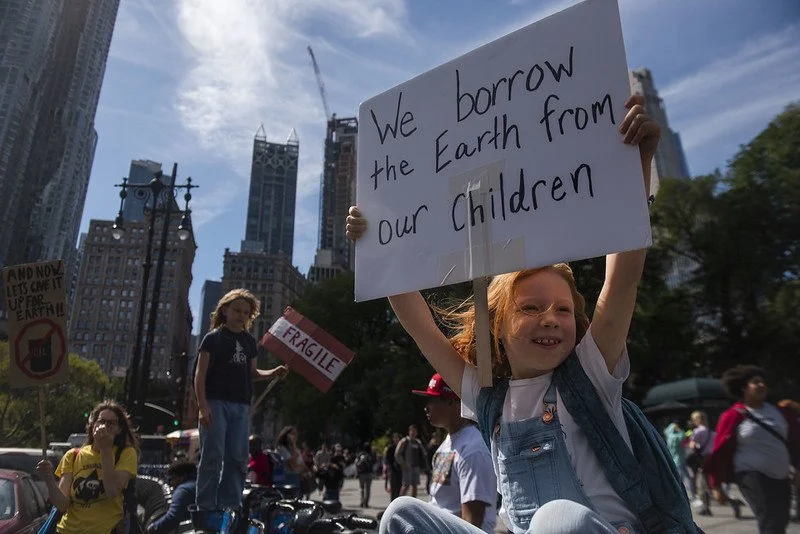
Scenes from the 20 September 2019 demonstration in downtown New York as part of the youth-lead global #ClimateStrike. Young people led millions around the world in marches demanding action on climate change days before the UN Climate Action Summit (23 September). Photo: UN Women/Amanda Voisard
by Dr. Don Haas
Last updated: April 15, 2026
On November 4, 2025, at the meeting of the Board of Regents, the Regents provisionally adopted instructional requirements for personal finance and climate education, marking the shift to the next phase in implementing new graduation measures. See the press release from the New York State Education Department (NYSED) and the new webpage from NYSED related to climate change education. The proposed amendment was approved for permanent adoption at the March 2026 Board of Regents meeting.
The resolution was adopted as proposed.
This is an important step forward for improving climate change education in New York State, and it is worthy of celebration!
This post will first address the new developments of November 2025, and then describe some positive changes that preceded it. Throughout the post there will be attention to what needs to happen to further these efforts.
NYSED’s Climate Education webpage (same link as above), has a detailed FAQ that is worthwhile reading. The pages, Climate Education Guidance & Resources, and Climate Education Topics & Grade Bands remain sparse at the writing of this update (April 15, 2026), but more content may be added in the near future.
The rollout of these new expectations will formally begin with the 2027-28 school year for middle (5-8) and high school (9-12) grade bands, and the 2028-29 school year for the elementary (K-4) grade band, though districts can begin before the official rollout.
The key topics identified for climate change are:
Causes of Climate Change
Impacts of Climate Change
Solutions for Climate Change
The specifics of what implementation will look like are vague. More detailed information is expected in March 2026, and there is opportunity for public input on the proposed regulation (see below).
The Regents meeting included teachers Lynn Shon and Andrew Zimmerman from New York Harbor Middle School sharing one example of what middle school curriculum might include, with Lynn and Andy highlighting what they are already doing. The slide deck is here. The teachers’ slides were 12 to 20. Slide 18 is shown below.
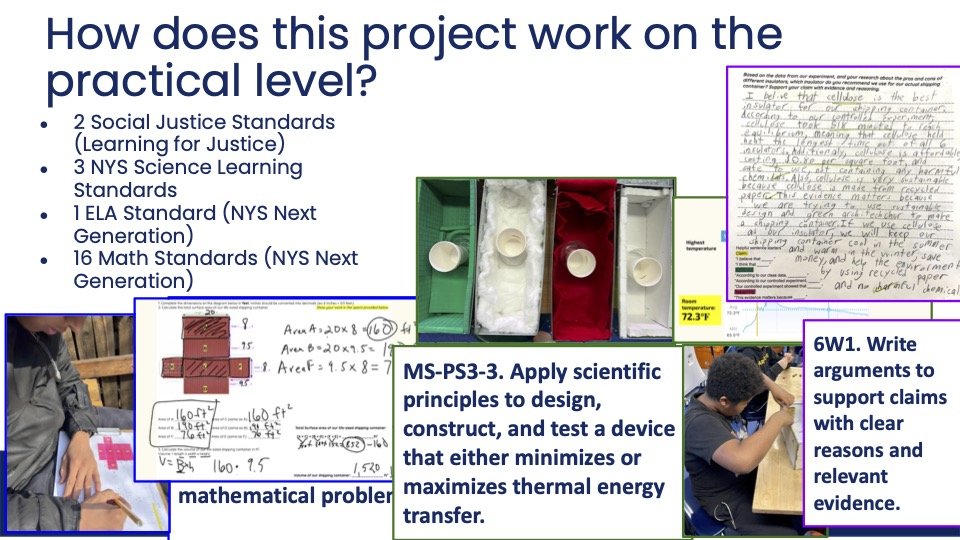
One slide from the presentation by teachers Lynn Shon and Andrew Zimmermanat the November 3, 2025 meeting of the Regents of the State of New York. The full slide deck is here and includes additional information on both changes in climate education and personal finance education.
What about funding?
While the actions of the Regents enshrine climate change education in policy, the effort requires substantial funding to ensure successful implementation of the new policy. That funding is not yet in place. You can help secure that funding by contacting the Governor and urging her to include funding in her 2026 budget. The Climate and Resilience Education Task Force provides guidance on how to do that via email or postcard here.
Written comments on the proposed amendment are now being accepted (they must be received by January 19, 2026) and can be submitted to [email protected] and/or mailed to:
Santosha Oliver, Assistant Commissioner,
NYS Education Department,
Office of Standards & Instruction,
89 Washington Avenue, Room 860 EBA, Albany, NY 12234
Earlier Recent Changes in Climate Education in New York State
New Science Standards & Exams
While these new expectations are important, they are not the first improvement to climate education in the state. In June of this year, new Regents science exams debuted in New York State for students in Earth & Space Science, and in Life Science: Biology. These exams pay considerably more attention to climate change and energy than the exams they replaced. New exams for Physical Science: Chemistry and Physical Science: Physics will debut in June of 2026, and they too are expected to pay substantially more attention to climate and energy issues.
In 2017, the New York State Science Learning Standards (NYSSLS) were officially adopted by the New York State Board of Regents. NYSSLS is based on and closely adheres to the Next Generation Science Standards, which were published with support from the National Academies in 2013. Roll out of NYSSLS began at the elementary level, and was delayed by the pandemic. The prior standards and exams were based upon the 1994 National Science Education Standards. Change was overdue.
Implementation of NYSSLS was finally realized in most high school biology and Earth science classes in the 2024-2025 academic year. Districts had a choice of offering the NYSSLS-based exams in these courses for the first time in either June of 2025 or June of 2026. NYSSLS-based chemistry and physics exams will debut in June of 2026. New York City chose to adopt in the first year available for all four exams, making it so that the majority of students in the state took or will take the new exams in the first year offered. (Of New York State’s 2.4 million K-12 students, 1.1 million are in New York City schools).
The June 2025 Earth & Space Science Regents Examination almost certainly contains more climate and energy-related content than any other statewide high school examination in the US. The August exam did not include as much climate content as the June exam, but still far more than what was included on prior exams. The Life Science: Biology Regents Examination also includes substantial climate content than the exams based upon the older standards.
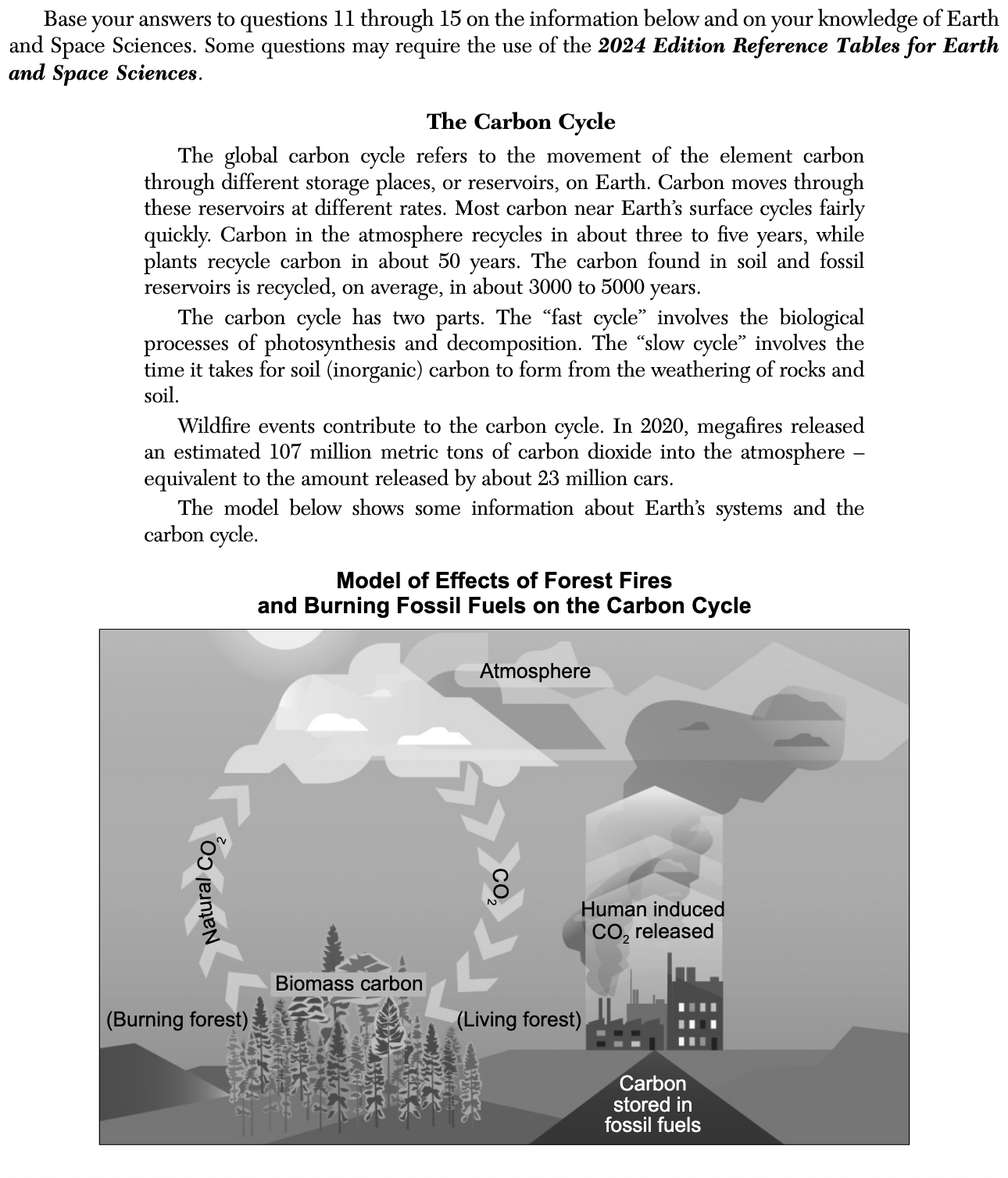
The introduction to a cluster of questions on the June 2025 Earth & Space Sciences Regents Examination. The exam includes several question clusters.
Released sample items for the coming examinations in physics and chemistry indicate that these exams will also see considerably more climate and energy content than what has been included in examinations prior to this school year.
This is good news, but it is important to emphasize that climate change is an interdisciplinary and cross-curricular issue.
Non-science Disciplines
Prior to this past June, the Regents Examination that was most likely to include substantial climate-related content was the English Language Arts (ELA) Examination. The argument essay on that exam includes readings that student respond to, and these included substantial attention to climate and energy issues on four of the last eight examinations:
The January 21, 2025 REGENTS EXAMINATION IN ENGLISH LANGUAGE ARTS include several readings on veganism that addressed climate change.
The June 14, 2024 REGENTS EXAMINATION IN ENGLISH LANGUAGE ARTS includes several readings on vertical farming that address climate change.
The August 16, 2023 REGENTS EXAMINATION IN ENGLISH LANGUAGE ARTS includes several readings on styrofoam that address climate change. Styrofoam is both made from petroleum and its manufacture uses hydrofluorocarbons (HFCs), which are a powerful greenhouse gases.
The June 14, 2023 REGENTS EXAMINATION IN ENGLISH LANGUAGE ARTS includes several readings on solar geoengineering that address climate change in some depth.
In other disciplines’ Regents Examinations, climate change has been nearly invisible. The state’s Portrait of a Graduate and New York Inspires initiatives require instruction in financial literacy and climate education (effective SY 26-27), but what this looks like has not been clearly defined. The Seal of Civic Readiness offers an opportunity for students to engage in climate action and receive formal recognition for it, but this is an optional program. Only 14,000 students statewide have received it since 2022, though participation has grown in each year of the program. Approximately 200,000 New York State students graduate from high school every year.
What You Can Do to Support Positive Change?
Climate change education in New York State is in the midst of transformation and that promises to substantially improve it! While these changes have been slow in coming, it appears positive changes have already happened and more are in the pipeline. While the changes approved this week do not require beginning implementation until the 2027-28 school year for middle and high school and the 2028-2029 school year for elementary grades, schools and teachers can begin implementation immediately. That is, teachers can take immediate action on the issue. And, anyone can comment on the proposed changes, and encourage the Governor to adequately fund them. And, again, celebrate that climate education is improving in New York State!
See the Climate & Resilience Education Task Force’s Policy Page for a feedback template and other resources.
PRI provides resources and professional development programming to help teachers, schools, school districts, and BOCES that will help with these changes!
Explore resources from PRI’s Center for Climate Change Education!
Contact PRI’s Director of Teacher Programming, Don Haas, for a free consultation on professional development programming.
Selected Relevant NYSED Webpages & Documents:
NY Inspires: A Plan to Transform Education in New York State Press release with embedded links; November 4, 2024
Climate Education subpages:
Seal of Civic Readiness Pull-down menus within the page:
Civic Readiness Resource Toolkit
Application Process and Guidance Documents
Civic Readiness Capstone Project
Approved Seal of Civic Readiness Schools (hundreds of schools!)
Frequently Asked Questions
March 2026 Meeting Climate was discussed on March 10, under the heading, Committee: P-12 Education. This includes a document, BR (CA) 5 - REVISED with a summary of public comments and NYSED’s responses to those comments. The climate-specific comments begin on page 12 of the document. The department responses each conclude with some version of, “No changes to the proposed rule are necessary.”
November 2025 Meeting Climate Education (and Personal Finance Education) were discussed during the P-12 portion of the meeting.
Inclusion in New York State Register - see the bottom of page 11 to the top of page 12.