

Through the Eyes of the Experts: Earth's Energy Imbalance with Dr. Daniele Visioni

Dr. Daniele Visioni, as rendered by DALL-E as a LEGO figurine, discussing solar radiation management.
By Dr. Toby Ault, Associate Professor in Department of Earth and Atmospheric Sciences at Cornell University and PRI Research Associate
March 19, 2026; Originally published January 6, 2026 on LinkedIn
Electricity
If I were to reduce my conversations with Cornell University’s Dr. Daniele Visioni to a single physical phenomenon, it would have to be electricity. He stopped by my office late in the fall semester, fresh from teaching his packed climate dynamics course, and still radiating an almost zealous enthusiasm for quantitative reasoning. Yet his buoyant energy is balanced by the stakes and risks of the research he does because he works on something that has long been considered dangerous to even broach—a veritable third rail of climate science.
Dan is one of the few top-tier climate scientists willing to ask a question most of us would rather avoid: what if greenhouse gas reductions do not happen fast enough? What if we need to reflect more sunlight to offset the effects of CO₂?
For decades, these questions lived on the margins of climate science, treated as fringe at best and taboo at worst. My first introduction to the topic was over 20 years ago when I was told, "It would be like amputating your head to get rid of your migraines." For an early-career climate scientist to specialize in such an emotionally charged (and morally complicated) research area would have been nearly unthinkable until relatively recently. Even now, Dan still faces his fair share of resistance to even doing the research.
Notwithstanding the resistance he has faced, Dan's research is both academically rigorous and highly relevant to political leaders: he is regularly invited to speak with policymakers and foreign heads of state about the risks, hazards, and feasibility of geoengineering. He's given TEDx talks, and earlier this year, he participated in the 2025 Isaac Asimov Memorial Debate, hosted by Neil DeGrasse Tyson.
Hidden Beauty
Once the espresso kicks in, Dan and I start talking about the beauty of mathematics and physics. He speaks of Maxwell’s equations as exquisite pieces of fine art. Without physics, he reminds me, you cannot understand the world as it actually is.
Physics is a compact, precise, albeit still imperfect, system for describing the universe across scales. It can be used to make predictions about phenomena we have never observed, but ought to exist if we look for them with the right tools, and it can predict how entire systems will evolve under certain physical constraints.
For example, you do not need observations of global warming to understand the core physics of the greenhouse effect. Earth is heated by sunlight, but it emits longwave radiation (if it did not, then it would very quickly reach temperatures of the sun). Our eyes cannot see infrared radiation, but certain molecules (greenhouse gases) can absorb it. When they do, they vibrate more quickly and bump into their neighbors, which is what warms the atmosphere.
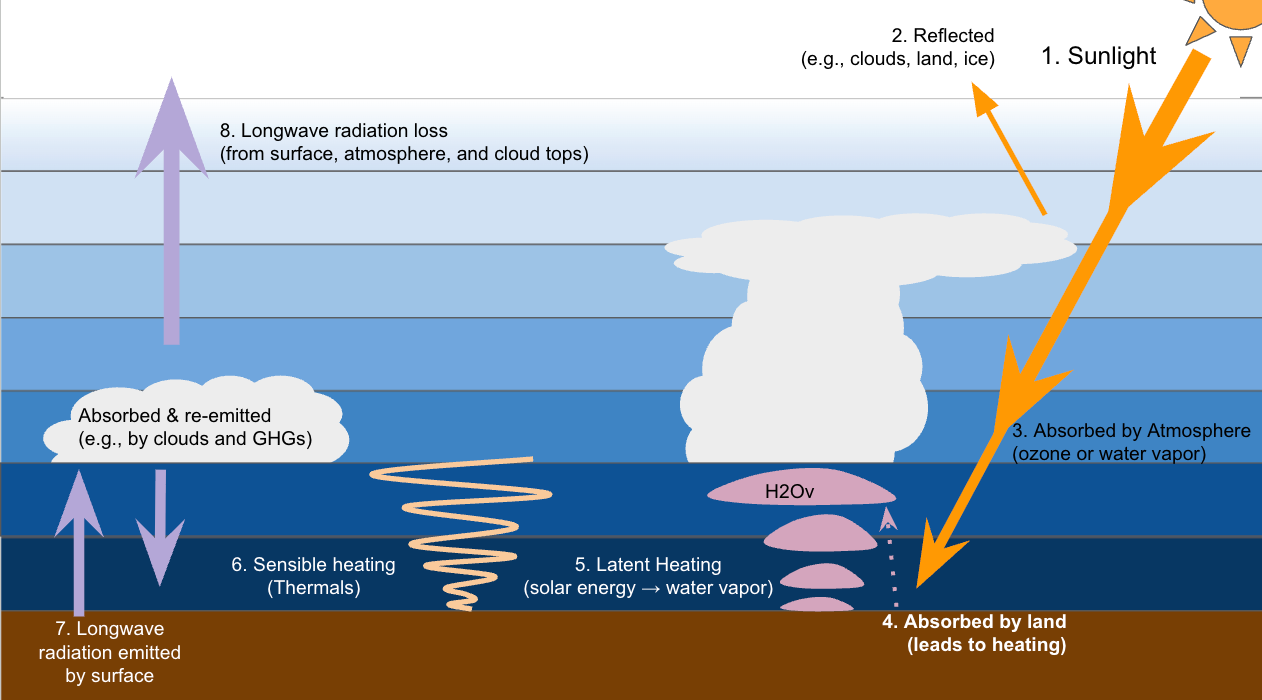
Schematic diagram of Earth's energy balance (generated with Google Slides).
Picture the equals sign (=). Those two parallel lines of equal length tell you that what is on the left of an equation is equivalent to what is on the right. In physics and mathematics alike, we might say that what is on the left is perfectly balanced by what is on the right.
The Earth's surface energy budget is not in balance. Decades of increasing greenhouse gas concentrations mean that slightly more energy is being trapped near the surface than is leaving. The result? Warming.
Dan uses atmospheric chemistry, physics, mathematics, and climate modeling to look realistically at all of our options for restoring balance. In an ideal world, this would mean quickly reducing our fossil fuel emissions and developing new technologies to remove excess CO₂ from the atmosphere while simultaneously promoting biological processes that naturally remove carbon.
Ours is not an ideal world, and while there is no long-term substitute for reducing emissions, we may face a future very soon where other climate intervention strategies will need to be explored if we are to stabilize global temperatures before it is too late. Dan's research looks at those climate intervention strategies, in particular the ones that would entail using stratospheric aerosols to reflect more sunlight.
A Primer on Scales
Greenhouse gas emissions are measured in gigatons of CO₂, yet to most people, that unit probably seems abstract. To put that into perspective, consider this: a Prius weighs about 1,400 kg (3000 lbs) or 1.4 metric tons. If you imagine a parking lot with 714 Priuses, the total mass of all of those Priuses would be about 1000 metric tons.
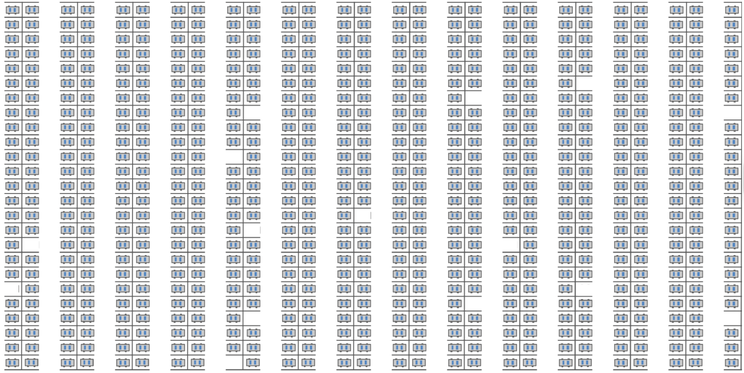
Schematic drawing of a parking lot with 714 Priuses, which together would weigh about 1000 metric tons.
A gigaton is a billion metric tons. That means we would need one million parking lots like the one depicted above to have in total one gigaton of Priuses. In other words, we would need about 714 million Priuses to total just one gigaton. That number (714 million cars) is about half of all passenger vehicles in the world today.
The relative scales of 1000 metric tons (714 Priuses) to on gigaton (714 Priuses) are shown by the areas of the circles depicted below.
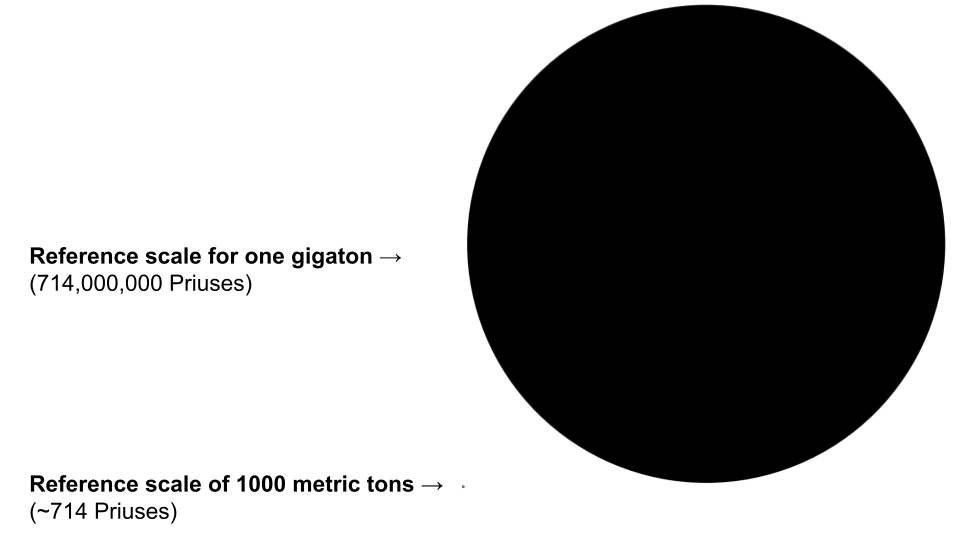
Relative areas of 1000 metric tons (small black dot, lower left) to a gigaton (large black circle).
A Half-Baked Solution
A few weeks after our first conversation, I followed up with Dan at the end of the American Geophysical Union Fall Meeting. I had recently been in California, and I wanted to run by him a few ideas I'd heard from enthusiastic Cornell alumni who had questions about options for CO₂ drawdown.
I was in Ithaca, watching graupel fall sideways and strike the window of my office as the light faded early. Dan was about to check out of his hotel room and had completely packed his computer, notebooks, pencils, and anything else he could have used to do a "back of the envelope" calculation. "This will be perfect," I thought, "I'll run the ideas past him and see how he handles them in real time. No AI. No calculator. Not even a cheap hotel pen and a notepad!"
I've included the almost exact transcript below, edited for clarity and word choice:
ME: Alright. Suppose I have a company. Suppose I want to grow hemp, turn it into building materials, and get paid for drawing carbon out of the atmosphere. How would you evaluate this idea?
DAN: You’d have to start by looking at the scales. Global emissions are on the order of 40 gigatons of carbon dioxide, or about 10 gigatons of carbon, per year. Even if we decarbonize fully and do it very soon, there's still going to be residual emissions from the past in the atmosphere. So, if you want to matter, you have to operate at that scale, and you have to do it every year. You have to be thinking in units of gigatons.
ME: Okay. So how do you even begin to think about that?
DAN: You break it down. How much biomass can you grow per square meter in a year? Let's be optimistic. What is your target?
ME: Well, I am being ambitious. I am claiming that with vertical farming, I can harvest 10 kg of dry biomass per year.
DAN: Ok, sure. Fine. Then you ask how much of that is carbon? Most of the dry mass is carbon. Let’s say eighty percent. Now you’re at eight kilograms of carbon per square meter.
ME: And that’s already assuming very good yields.
DAN: Yes, probably unrealistically good yields. Now you ask how much of that carbon you can actually keep out of the atmosphere. Storage is not perfect. Some of it leaks. Some of it gets burned. Even if you’re generous, maybe you keep seventy-five percent.
ME: Yeah, the idea is to use it as a building material for long-term storage.
DAN: Right, so about six kilograms of carbon per square meter per year is the best case scenario. Now take the target. Ten gigatons of carbon is 10¹³ kilograms. Divide that by six kilograms per square meter... That’s on the order of 10¹² square meters.
ME: Ok...
DAN: Now, convert that to square kilometers and you’re talking about roughly one to two million square kilometers.
ME: That’s like country-scale, isn't it?
DAN: Continental-scale. You’re approaching the size of like a quarter of Australia, I think. And you need to plant and harvest that amount every year.
ME: I am googling the surface area of Australia right now––7.7 million square kilometers.
DAN: Yeah, perfect. Exactly. And that's before harvesting. Before processing. Before transport. Before droughts, fires, or crop failures. Before accounting for any of the other carbon inputs you'd need just to build the infrastructure and harvest the product.
ME: So you might need an area more like "the entire continent of Australia."
DAN: Yes, but presumably the people who live there would have something to say about it.
ME: Right, of course. So maybe we do it out in the open ocean. Say we collect all the floating plastic garbage and make a synthetic floating island the size of Australia and stick it somewhere near the equator. Then what?
(At this point I can almost hear Dan's eyes rolling, but he sticks with the "bit").
DAN: Okay, sure. You can say that the ocean is bigger than land, and that Australia matters to people in a way the open ocean might not. That’s why people talk about kelp farming or other ocean-based approaches. In principle, it sounds easier. You can submerge biomass. You don’t have to buy land, but...
ME: But...
DAN: But then the same questions come back. You would be talking about a patch of ocean the size of Australia, with essentially no biodiversity. You would have to control that system. You would need infrastructure in the middle of the ocean, in regions that are exposed to storms, marine heat waves, and long-term climate variability.
DAN: You would also be building infrastructure on scales that are several orders of magnitude larger than anything we've ever built before. And you would need a bunch of technologies that don't exist yet and to make them would require an enormous amount of energy, which presumably would have to come from carbon, so you would have to think about how you're going to offset that carbon cost.
ME: I am planning to build it in Europe using low-carbon energy and modular macroscale-LEGO technology.
DAN: Fine, great. You would also have to think about huge unintended consequences. A structure that large would interfere with circulation, heat transport, probably things like the Walker circulation. These are global systems. We don’t have a way to predict all of that reliably. So you could easily be doing enormous damage before you even know whether the thing is working.
ME: Sure, but if we can price carbon, these things will basically pay for themselves, right?
DAN: Well, we don't actually know. In principle, yes, if you were paid the right amount to definitively lock carbon out of the atmosphere, sure, you could start doing this. And if you bury carbon underground, you can at least say where it is and whether it leaks, same if you use it for your building materials. But in the ocean, you don’t really know. You don’t know if the carbon stays down or comes back out. You might not be able to detect that for decades.
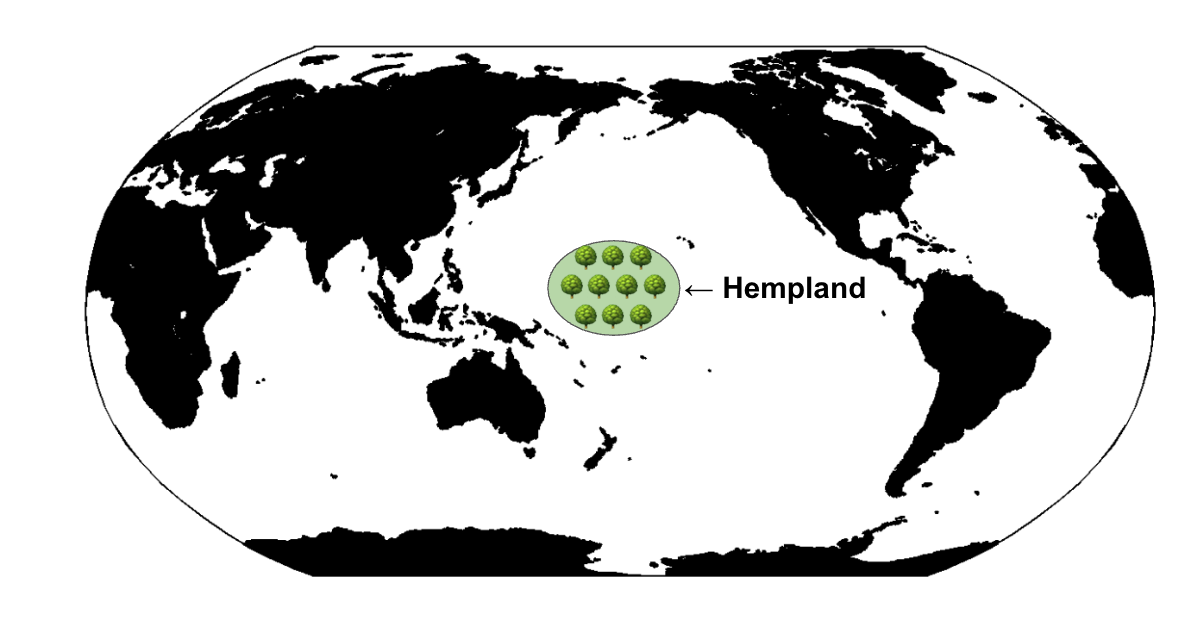
Approximate scale of the imagined "new floating continent" I would need for hemp cultivation to offset our current annual emissions based on Dan's back-of-the-envelope calculations (which he made without any envelope).
Continental-scale consequences
The list of considerations Dan brought up goes on: land used for carbon drawdown cannot be used for food production. If you want to make biofuel, that doesn't remove CO₂ from the atmosphere in the long term. Monoculture at the scale of the entire Australian continent carries consequences for biodiversity that cannot be easily reversed. Even if you tried to do it across multiple regions throughout the world, you would be at risk of erasing entire ecosystems or diminishing global food production.
You also have to think about Indigenous land rights, national sovereignty, and ecological value, none of which are side issues because at these scales they are all going to matter.
Yet Dan insisted that none of this argues that biological approaches (or any carbon sequestration methods) are useless. To the contrary, his verdict was that it was worth doing:
I think it's a good idea and you should do it! Just be realistic about how much you can do, how long it will take, and how much energy you're going to need. I mean, the alternative is to do nothing at all, right?
"The alternative," he reminded me, "could be substantially worse." And this is precisely why Dan was drawn into the topic of geoengineering research in the first place: if we do not get our emissions under control soon and we do not develop technology to pull carbon out of the atmosphere on the scale of gigatons, then we are sending our entire climate system lurching towards an unprecedented energy imbalance of three Watts per square meter (3 W/m²).
Out of Balance
An imbalance of 3 W/m² might not mean anything to you, but if you think like Dan does, it is alarming. Here's why: Earth's surface area is about 510 trillion square meters, so when integrated over the entire planet, it would mean that about 1.5 × 10¹⁵ joules of excess energy will be added to the climate system every second if we stay on our current trajectory. That imbalance adds up to the following energy equivalents:
The propulsion power of 8 million Nimitz-class aircraft carriers operating at full capacity,
The electrical energy output of 1.5 million nuclear power plants (1000 MW),
The heat energy released by a one megaton thermonuclear warhead being detonated every second,
The energy release of Mt. St. Helens erupting every 23 minutes (including heat, motion, and seismic waves),
The total energy released as seismic waves by the 1989 6.9 magnitude Loma Prieta (San Francisco) earthquake every single second.
Turn Down for What?
The excess energy from greenhouse gas emissions will accumulate in the oceans, melt ice sheets, raise sea level, and shift the circulation patterns that govern droughts, floods, heat waves, and wildfires. Carbon dioxide removal addresses the cause of the imbalance, but it operates slowly and at scales that remain discouragingly small for the foreseeable future.
Geoengineering is not a substitute for emissions reductions, nor a permanent fix, but it targets the imbalance directly by “turning down” sunlight to counteract the trapped heat. Proposed technologies for doing this include space mirrors, stratospheric aerosol injections, or artificially brightening marine clouds (among others). No controlled experiments have yet been done at relevant scales on our actual planet, but Dan's leadership in this field looks at climate model simulations of these theoretical interventions.
In purely physical terms, reducing the total amount of incoming sunlight by 3 W/m² could offset the surface energy imbalance caused by increasing greenhouse gas concentrations this century. Whether such an intervention should ever be deployed in the real world, the one we actually have to live in, is a moral question that physics alone cannot address.
No Easy Way Out
Dan does not offer any easy answers. He is not going to tell you what you should think, just how you should think about the scales and the stakes of climate change this century. He wants to see more experts, more challenges to his own work using the same physical reasoning, scale considerations, and moral thinking that he himself applies to his research; he worries that the field is too small and has been stigmatized for too long.
The worst situation is having only a few groups working on this, because then assumptions don’t get challenged and uncertainty stays hidden.
While it has often been a rough and lonely road, Dan's expertise is gaining international recognition. He shared that this was the first time he went to AGU and had people actually come up to him and acknowledge that the research might be needed after all, and some even apologized if they had been dismissive.
Importantly, Dan is serving as a lead author on the upcoming IPCC assessment, working on a new chapter focused on temperature overshoot (Chapter 9) and pathways toward stabilization. By the time this report is finalized, the world will almost certainly have passed 1.5°C of warming by every relevant metric. The task now is no longer to ask whether we will overshoot, but by how much, for how long, and what it would physically take to stabilize temperatures afterward. That reality forces more of us to confront the tradeoffs, risks, and limitations of carbon dioxide removal, the reversibility of climate impacts, and the role, if any, of solar radiation management.
His work is not advocacy, but rather a physics-based accounting system of carbon and energy on the giga-, tera-, and peta- scales. Accounting might not be glamorous, but it is honest. And an honest appraisal of our limited, imperfect options, alongside their risks and unintended consequences, might be the best we can do for right now.
Some people would rather not touch the topic of solar radiation management at all, believing that even doing the research is its own form of moral hazard. Today, as emissions increase and demand for electricity grows at rates that have not been seen in generations, that position is becoming less defensible; our options for stabilizing the climate system this century are running thin.
Think of it like this:
Behind door number one, we do very little and stay on our current course—using the atmosphere as a dumping ground for excess CO₂ while the oceans absorb the heat, glaciers melt, sea level rises, and a volatile hothouse climate displaces or kills billions later this century, leaving a planet that will take tens of thousands of years to recover.
Behind door number two, we allow a small number of actors to fight pollution with pollution, haphazardly altering the stratosphere without shared design constraints, clear objectives, or global accountability.
Behind door number three—
References
Zhao, M., Cao, L., Visioni, D., & MacMartin, D. G. (2025). Response of tipping elements to different strategies of stratospheric aerosol injection. Earth’s Future, 13(12), e2025EF006736. https://doi.org/10.1029/2025EF006736
Brody, E., Zhang, Y., MacMartin, D. G., Visioni, D., Kravitz, B., & Bednarz, E. M. (2025). Using optimization tools to explore stratospheric aerosol injection strategies. Earth System Dynamics, 16(4), 1325–1341. https://doi.org/10.5194/esd-16-1325-2025
Bednarz, E. M., Haywood, J. M., Visioni, D., Butler, A. H., & Jones, A. (2025). How marine cloud brightening could also affect stratospheric ozone. Science Advances, 11(20), eadu4038. https://doi.org/10.1126/sciadv.adu4038
Visioni, D., Robock, A., Roberts, K. E., Lee, W., Henry, M., Duffey, A., Hirasawa, H., & others. (2025). Finalizing experimental protocols for the Geoengineering Model Intercomparison Project (GeoMIP) contribution to CMIP7. Bulletin of the American Meteorological Society, 106(10), E2029–E2035. https://doi.org/10.1175/BAMS-D-25-0191.1
Tilmes, S., Bednarz, E. M., Jörimann, A., Visioni, D., Kinnison, D. E., Chiodo, G., & others. (2025). Stratospheric Aerosol Intervention experiment for the Chemistry–Climate Model Initiative. Atmospheric Chemistry and Physics, 25(12), 6001–6023. https://doi.org/10.5194/acp-25-6001-2025
Beckage, B., Lacasse, K., Raimi, K. T., & Visioni, D. (2025). Models and scenarios for solar radiation modification need to include human perceptions of risk. Environmental Research: Climate, 4(2), 023003. https://doi.org/10.1088/2752-5295/addd42
Haywood, J. M., Boucher, O., Lennard, C., Storelvmo, T., Tilmes, S., & Visioni, D. (2025). World Climate Research Programme lighthouse activity: an assessment of major research gaps in solar radiation modification research. Frontiers in Climate, 7, 1507479. https://doi.org/10.3389/fclim.2025.1507479
Rezaei, A., Moore, J., Tilmes, S., Visioni, D., & Hussain, A. (2025). Multi-model future world aridity and groundwater recharge changes with and without stratospheric aerosol intervention under high warming scenario. Geophysical Research Letters, 52(17), e2025GL117234. https://doi.org/10.1029/2025GL117234
Bednarz, E. M., Goddard, P. B., MacMartin, D. G., Visioni, D., Bailey, D. A., & others. (2025). Stratospheric aerosol injection could prevent future Atlantic Meridional Overturning Circulation decline, but injection location is key. Earth’s Future, 13(8), e2025EF005919. https://doi.org/10.1029/2025EF005919
Quaglia, I., & Visioni, D. (2024). Modeling 2020 regulatory changes in international shipping emissions helps explain anomalous 2023 warming. Earth System Dynamics, 15, 1527–1541. https://doi.org/10.5194/esd-15-1527-2024
Farley, J., MacMartin, D. G., Visioni, D., & Kravitz, B. (2024). Emulating inconsistencies in stratospheric aerosol injection. Environmental Research: Climate, 3(3), 035012. https://doi.org/10.1088/2752-5295/ad519c
Brody, E., Visioni, D., Bednarz, E. M., Kravitz, B., MacMartin, D. G., Richter, J. H., & Tye, M. R. (2024). Kicking the can down the road: understanding the effects of delaying the deployment of stratospheric aerosol injection. Environmental Research: Climate, 3(3), 035011. https://doi.org/10.1088/2752-5295/ad53f3
Visioni, D., Robock, A., Haywood, J., Henry, M., Tilmes, S., MacMartin, D. G., & others. (2024). G6-1.5K-SAI: a new Geoengineering Model Intercomparison Project (GeoMIP) experiment integrating recent advances in solar radiation modification studies. Geoscientific Model Development, 17(7), 2583–2596. https://doi.org/10.5194/gmd-17-2583-2024
Visioni, D., Quaglia, I., & Steinke, I. (2024). A living assessment of different materials for stratospheric aerosol injection—Building bridges between model world and the messiness of reality. Geophysical Research Letters, 51(10), e2024GL108314. https://doi.org/10.1029/2024GL108314
Quaglia, I., Visioni, D., Bednarz, E. M., MacMartin, D. G., & Kravitz, B. (2024). The potential of stratospheric aerosol injection to reduce the climatic risks of explosive volcanic eruptions. Geophysical Research Letters, 51(8), e2023GL107702. https://doi.org/10.1029/2023GL107702
Laakso, A., Visioni, D., Niemeier, U., Tilmes, S., & Kokkola, H. (2024). Dependency of the impacts of geoengineering on the stratospheric sulfur injection strategy—Part 2: How changes in the hydrological cycle depend on the injection rate and model used. Earth System Dynamics, 15, 405–427. https://doi.org/10.5194/esd-15-405-2024
Zhang, Y., MacMartin, D. G., Visioni, D., Bednarz, E. M., & Kravitz, B. (2024). Hemispherically symmetric strategies for stratospheric aerosol injection. Earth System Dynamics, 15, 191–213. https://doi.org/10.5194/esd-15-191-2024
Bednarz, E. M., Visioni, D., Butler, A. H., Kravitz, B., MacMartin, D. G., & Tilmes, S. (2023). Potential non-linearities in the high latitude circulation and ozone response to stratospheric aerosol injection. Geophysical Research Letters, 50(22), e2023GL104726. https://doi.org/10.1029/2023GL104726
Bednarz, E. M., Butler, A. H., Visioni, D., Zhang, Y., Kravitz, B., & MacMartin, D. G. (2023). Injection strategy – a driver of atmospheric circulation and ozone response to stratospheric aerosol geoengineering. Atmospheric Chemistry and Physics, 23, 13665–13684. https://doi.org/10.5194/acp-23-13665-2023
Visioni, D., Robock, A., Haywood, J., Henry, M., & Wells, A. (2023). A new era for the Geoengineering Model Intercomparison Project (GeoMIP). Bulletin of the American Meteorological Society, 104(11), E1950–E1955. https://doi.org/10.1175/BAMS-D-23-0232.1